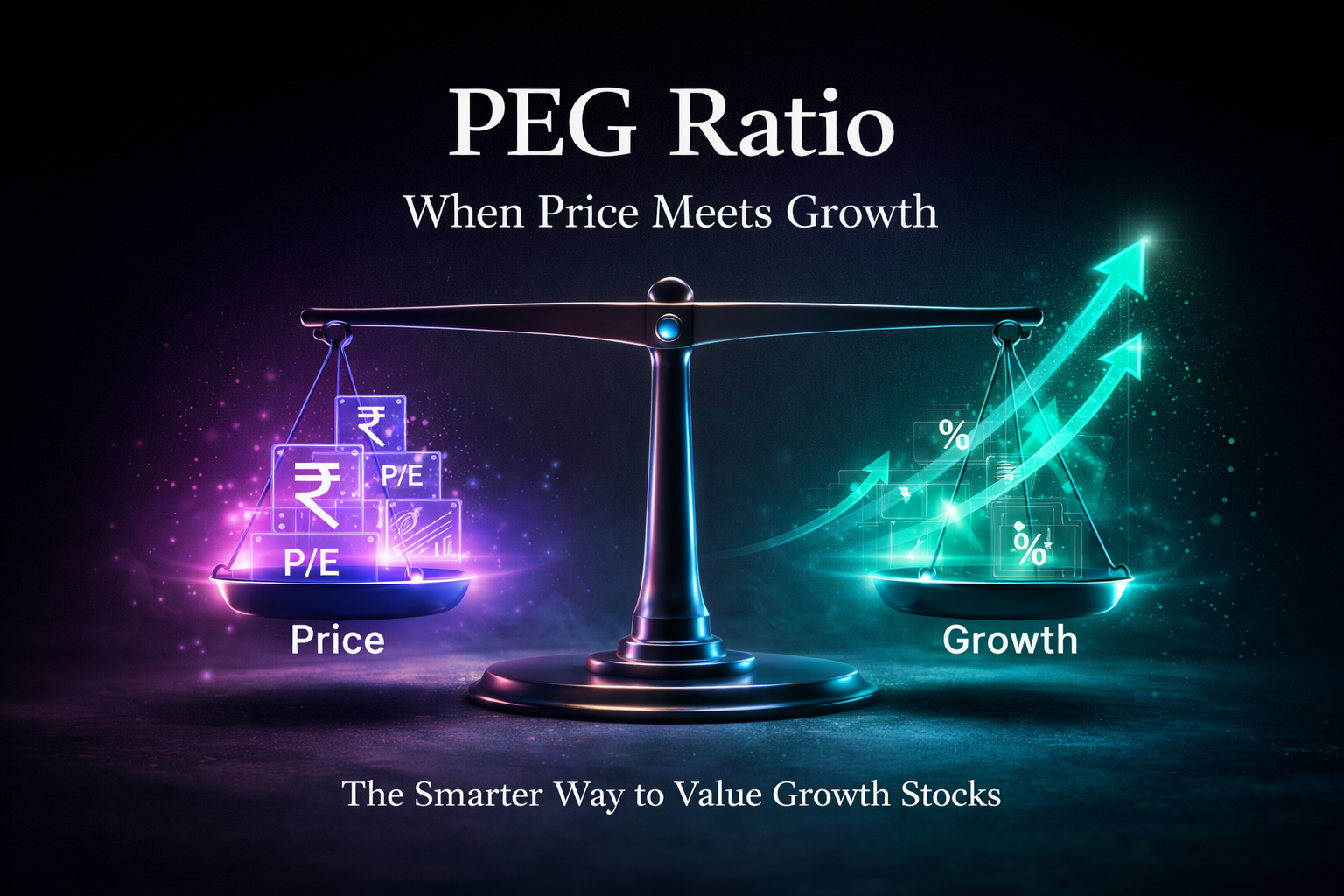
PEG Ratio Explained: How to Find Undervalued Growth Stocks
PEG Ratio Explained – How to Find Undervalued Growth Stocks
This content is for educational purposes only and does not constitute investment advice. Please consult a SEBI-registered Research Analyst before making any investment decisions.
📌 Table of Contents
➜ What is PEG Ratio?
PEG Ratio (Price/Earnings to Growth Ratio) improves the traditional P/E Ratio by factoring in a company’s earnings growth rate.
In simple words, PEG tells you whether a stock’s price is justified based on how fast its earnings are expected to grow.
➜ Why PEG Ratio is Important
- P/E alone ignores growth
- PEG adjusts valuation with earnings growth
- Helps identify undervalued growth stocks
- Popular among long-term growth investors
➜ PEG Ratio Formula
PEG Ratio = (P/E Ratio) / Earnings Growth Rate
Earnings growth is usually taken as the expected annual EPS growth (in percentage).
➜ PEG Ratio Example
| Parameter | Value |
|---|---|
| P/E Ratio | 20 |
| Expected EPS Growth | 20% |
PEG = 20 / 20 = 1
This indicates fair valuation relative to growth.
➜ How to Interpret PEG Ratio
| PEG Value | Interpretation |
|---|---|
| < 1 | Potentially undervalued growth stock |
| ≈ 1 | Fairly valued |
| > 1 | Expensive relative to growth |
➜ PEG Ratio vs P/E Ratio
| Factor | P/E Ratio | PEG Ratio |
|---|---|---|
| Growth Adjustment | No | Yes |
| Best for | Mature companies | Growth companies |
➜ What is a Good PEG Ratio?
- PEG < 1: Attractive growth valuation
- PEG ≈ 1: Fair valuation
- PEG > 1.5: Overvalued growth expectations
➜ Limitations of PEG Ratio
- Depends on estimated future growth
- Growth forecasts can be inaccurate
- Not useful for cyclical businesses
- Should not be used alone
➜ How Smart Investors Use PEG Ratio
- Combine PEG with EPS growth consistency
- Use PEG along with ROE & cash flows
- Avoid extremely high-growth assumptions
- Focus on long-term growth sustainability
➜ Final Conclusion
PEG Ratio is one of the best valuation tools for growth investors. It bridges the gap between price and growth, making it superior to P/E alone when analysing fast-growing companies.
Money Bells is a SEBI Registered Research Analyst. This content is purely educational.
.jpg)